

Seeking out the
5000 greatest films
in a century of cinema


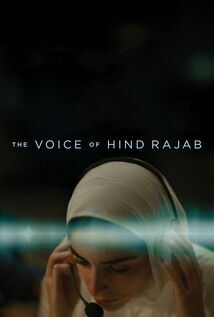

The Voice of Hind Rajab
Ṣawt Hind Rajab



Produced by Odessa Rae, James Wilson, and Nadim Cheikhrouha
Editing: Kaouther Ben Hania, Qutaiba Barhamji, and Maxime Mathis
Music: Amine Bouhafa
Release Date: 10 September 2025
Aspect Ratio: 2.39 : 1
Color: Color
Tunisian writer/director Kaouther Ben Hania follows up her Oscar-nominated Four Daughters with another excellent blending of reality and dramatization. The Voice of Hind Rajab reenacts the events of January 29, 2024, when a family in Palestine, following the orders of the Israeli army to evacuate their neighborhood, was gunned down by the soldiers, killing all but one passenger—the titular five-year-old girl, Hind Rajab. The movie is told entirely through the perspective of the Red Crescent volunteers who received an emergency call, at first from the little girl's cousin, who soon dies, and then stay on with Hind Rajab as they attempt to clear a safe route for an ambulance eight minutes away to safely enter the besieged area in Gaza and rescue her.
On a purely surface level, it's a real-life version of Gustav Möller's Danish film The Guilty, and the Antoine Fuqua/Nic Pizzolatto remake. But where both of those films are arguably more technically accomplished and more narratively intricate, playing out their fictional detective stories in real time, the real-world elements of this film make it far more impactful. The actors playing the Red Crescent volunteers are mostly shot in extreme close-up, so we can see how their inability to help this trapped girl renders them almost as helpless as she is. As they try to keep her on the line for hours, they must go through an intricate procedure to ensure that the rescuers don't get killed themselves. Since the Red Crescent doesn't talk directly to the Israeli military, it must go through the Red Cross, which then passes their requests to another organization that talks to the army. And even if all the conditions are met, there's still no guarantee that things won't go from bad to worse, or from unbearable to unthinkable.
The voices we hear on the other end of the phone and the phone recordings are the actual voices of the people recorded on January 29th, 2024. The actors prepared for this film by meeting the real people they played and rehearsing with actors playing the voices on the phone. But when they shot the picture, in chronological order, they were acting for the first time with the playback of the actual recordings of Hind Rajab and the others on the line. This adds a level of verisimilitude to the film and the performances that is not guaranteed. I can think of many ways this approach could have made the film feel inauthentic and self-conscious, but Ben Hania and her cast handle it well.
There are a number of things that don't work as well as they could have. For example, the passage of time is handled awkwardly, with the movie feeling like a real-time thriller in the style of The Guilty, but with occasional clumsy reminders of how many hours they've been on the phone with the girl. Still, the choice to tell this particular story, one of hundreds of thousands of horrific tales that could be told about this occupation, entirely from the perspective and viewpoint of the call center volunteers, is smart. This is also an example of how fictionalizing a true-life event was likely far more effective than telling the story via a documentary could have been. By placing us in the present tense, rather than having people look back and talk about past events, The Voice of Hind Rajab has a powerful and tragic immediacy.
Told entirely from the POV of Red Crescent emergency call-center volunteers, Kaouther Ben Hania's docudrama about a five-year-old girl begging to be rescued from a car trapped under fire in Gaza, explores the damned-if-you-do and if-you-don't when it comes to following procedures in wartime.