

Seeking out the
5000 greatest films
in a century of cinema


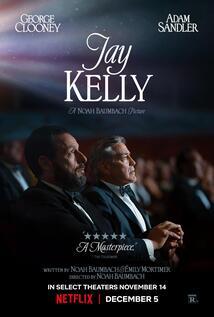

Jay Kelly



Produced by David Heyman, Noah Baumbach, and Amy Pascal
Editing: Valerio Bonelli and Rachel Durance
Music: Nicholas Britell
Release Date: 05 December 2025
Aspect Ratio: 1.66 : 1
Color: Color
Noah Baumbach (Greenberg, Frances Ha, Mistress America, The Meyerowitz Stories (New and Selected), Marriage Story—to name just his most recent excellent pictures) stunned me with this embarrassingly self-indulgent and underwritten mess that easily ranks as the writer/director's worst movie. The only thing I dislike more than Millennial Apology Porn is films about late-middle-aged showbiz dudes feeling (kinda) bad about how much they put their careers above their families. Movies like this seem like they've been created as therapy for the filmmaker, but it's the kind of feel-good therapy where the client doesn't actually make any progress; they just spend a pleasant 50-minute hour talking about themselves every week and getting a pat on the head. To express regretful personal sentiments artistically, you gotta create something artful. You can't just dash off a shallow collection of half-thought-out ideas and populate it with a great A-list that you hope will cover up how cobbled together the writing feels. If you're gonna make All That Jazz, you actually have to make All That Jazz.
Clooney's charm and charisma don't hide this picture's threadbare conceits. In fact, casting him as the titular Jay Kelly makes them all the more blatant. He's a very good actor, but he's headed up so many terrible movies, and everything he's directed has ranged from underwhelming (Confessions of a Dangerous Mind, Good Night and Good Luck, The Tender Bar) to total misfires (The Ides of March, The Monuments Men, Suburbicon) it's hard to take this character seriously as an artist and cut him any slack. Clooney manages to make this overprivileged and incurious protagonist come off more smug and unsympathetic than any actor I can imagine in the role.
Jay Kelly will go down in history as the only film in which Laura Dern gives a bad performance, though, in fairness to her, she's given nothing to play except a one-note showbiz cliché. Adam Sandler fares much better in the more substantive role of Jay's manager, Ron Sukenick, the one character with any depth at all. I won't be surprised if Sandler scores an Oscar nomination, but his supporting performance only looks special because it is amid a sea of poor turns from usually great actors like Billy Crudup, Stacy Keach, Jim Broadbent, Patrick Wilson, and Riley Keough. This is a movie about people explaining things to each other, then having fantasy sequences where they explain more to each other, then having flashbacks that show what they just explained to each other. Sandler and Dern are saddled with the worst of this in a scenes aboard a train where they remind each other of a defining moment in their relationship, in full detail so the audience knows what they're talking about, and then suddenly discover a key aspect of the story that somehow has never come up before even though (I think) they've been working fairly closely together for many years since).
The screenplay, co-written by Emily Mortimer, who also has a small role, covers some of the same thematic ground as in Mortimer's 2014 TV show Doll & Em, which she co-wrote and co-starred in with Dolly Wells. Mortimer played a successful British actress who hires her best friend to be her assistant, treats her like an underling, and then feels guilty about it, but not guilty enough to stop. This type of subject matter has grown increasingly common over my lifetime, to the point that so much of what appears on the big and small screens seems to be about the shallow lives of people in the entertainment industry. It's almost as if the folks writing this stuff haven't experienced much of life outside of their little bubble. I would expect someone of Baumbach's skill and sharp edge to have found the dark, accusatory, and ironic aspects of a story about a quintessentially shallow man trying to be introspective, only to find he lacks the depth to get to the bottom of what's bothering him. But, Lord help us, the director, writers, and all the actors approach this as if it were the one Garry Marshal ensemble holiday movie with something profound to say.
If you want to see a decent movie on this exact same subject, I can mildly recommend Hallie Meyers-Shyer's little film from the previous year, Goodrich. That picture, starring Michael Keaton as a workaholic art gallery owner so self-involved he doesn't even realize his young wife has a drug problem until she checks herself into rehab, succeeds because, while the film is told through the point of view of the aging not-so-great-dad, the perspective comes from his adult daughter (Mila Kunis), which provides the needed balance. This picture attempts that kind of balance by giving Sandler's manager character his own storyline, but we never fully buy Ron as a real guy. Sandler imbues him with heart, but he's still a one-dimensional idea of a character.
Does Jay Kelly really deserve a one-star rating? After all, this is not an unwatchable movie. Even though it is inferior to even the weakest of Baumbach's prior works (which, interestingly, is his previous directorial effort, White Noise), I would have probably given it a low-ranked two-star position had I not seen both Marty Supreme and Sentimental Value within the next 24 hours and been reminded that there are still people out there making great movies! Jay Kelly becomes a phenomenally embarrassing picture when viewed in the same year (let alone the same week) as Sentimental Value, which is also the story of an aging film industry veteran who didn't pay enough attention to his kids. Indeed, the two movies share a few similar scenes. But where Joachim Trier's film is a subtle masterpiece about reconciling dysfunctional family dynamics in the clumsy yet occasionally sublime ways humans can, Baumbach's picture is a hamfisted mess about cookie-cutter character types experiencing undercooked emotions, on-the-nose dialogue, and artless self-pity.
We might expect a filmmaker of Noah Baumbach's skill and edge to find the dark, ironic aspects of a story about a shallow man trying to be introspective, only to find he lacks the depth to get to the bottom of what's bothering him; instead, we get a maudlin, hamfisted mess of undercooked emotions, on-the-nose dialogue, and artless self-pity.