

Seeking out the
5000 greatest films
in a century of cinema


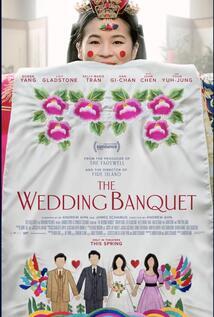

The Wedding Banquet


Editing: Geraud Brisson
Music: Jay Wadley
Release Date: 18 April 2025
Aspect Ratio: 1.66 : 1
Color: Color
Ang Lee and James Schamus's first major hit gets a millennial update from writer/director Andrew Ahn (Driveways, Fire Island). The 1993 indie romcom charmed with its fresh, innovative story of a gay Taiwanese immigrant happily living in Manhattan with his Jewish lover, who marries a woman from mainland China so she can get a green card and he can placate his interfering, traditionally minded parents. The contemporary update centers on four friends. Two are a lesbian couple in which one partner (Lily Gladstone) is not having much luck conceiving their child through expensive IVF treatments, while the other (Kelly Marie Tran) isn't even sure she wants a child because of her own mother issues. Two are a gay couple in which one partner (Han Gi-chan) is the scion of a wealthy Korean family who wants to marry his boyfriend so he can stay in America and pursue his art, but the boyfriend (Bowen Yang) has commitment and self-worth issues.
Just like in the original film, a sham marriage is set up, but this one feels born strictly out of the need for a story rather than from a credible, if comical, solution to the situation the characters find themselves in. The farcical concept is not used here for farce at all. Indeed, it's difficult even to call this romantic comedy a comedy. Really, this is a drama with a few light touches, but basically it's 103 minutes of characters trying to get over themselves. The main obstacles they face are entirely of their own making. The only situational barrier to happiness is the fact that one character who wants to have a baby can't get pregnant, but more than one possible solution is presented. I feel like any character from any other generation would jump on those solutions, and we might get an interesting serio-comic movie about navigating the options.
This version of The Wedding Banquet, co-scripted by Ahn and Schamus, lacks the obstacles that were present in 1993. These characters have full legal rights to marry; they have progressive mothers (heavy hitters Joan Chen and Youn Yuh-jung) who are kind, understanding, and helpful; there is almost zero cultural tradition they are honor-bound to uphold that's holding them back (other than a nearly dead Grandfather back in Korea whom we never see). The only thing in these characters' way seems to be that their generation is so addicted to emotional trauma that if none is actually present, they will manufacture it themselves. Of course, their self-induced struggles don't last very long. That's in part because this is a romcom, but also because the conflict here is mainly in these characters' heads. It shouldn't take more than 15 minutes of screen time for them to realize what an almost ideal solution they have. It is more than a little frustrating to watch a unique movie from an earlier era that transformed real situational, cultural, and emotional challenges into something funny and poignant, remade into a generic modern film that turns a situation that should be joyful and life-affirming into a self-pitying slog.
The fresh, charming 1993 queer indie romcom about overcoming clashes of culture through farse is transformed into a 2025 queer indie millennial melodrama about not being able to get over oneself.