

Seeking out the
5000 greatest films
in a century of cinema


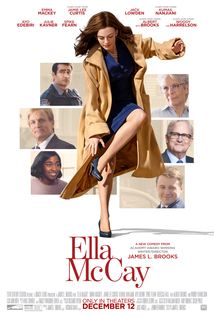

Ella McCay



Produced by Jennifer Simchowitz
Editing: Tracey Wadmore-Smith
Music: Hans Zimmer
Release Date: 12 December 2025
Aspect Ratio: 1.85 : 1
Color: Color
It may seem like a weird thing to say this month, but sometimes Quentin Tarantino has a point. While I can't say I agree completely with his long-time assertion that the last couple of films by great directors are always terrible, I do think it's true that most successful writer/directors reach a level of age, wealth, and status that renders it impossible for them to understand real life in the manner required to create a feature film that human beings can relate to. I was really hoping this wouldn't be the case with James L. Brooks, the peerless television writer who co-created the The Mary Tyler Moore Show, Taxi, and The Simpsons, adapted Larry McMurtry's complex novel Terms of Endearment into one of the best grown-up comedies of the 1980s, and crafted one of the most insightful and perfectly balanced blends of romantic comedy, workplace comedy, and social commentary with Broadcast News. I'm especially disappointed because, in his mid-'70s, Brooks started a fantastic creative relationship with Kelly Fremon Craig, producing her wonderful films The Edge of Seventeen and Are You There God? It's Me, Margaret?. Maybe the experience of shaping and sharpening those delicate pictures so successfully lured Brooks back into the writer/director chair, but however it happened, the results are not good.
Oscar-nominated for screenwriting for his first three produced features (all well-deserved nominations), Brooks makes the type of rookie mistake nearly every high-schooler trying to write their first terrible fantasy movie makes. He spends page after page, minute after minute, on exposition rather than storytelling. There's more world-building in this movie than in Avatar. The first act plays less like a narrative and more like a character bio come to life. Having Julie Kavner's character, Ella McCay's loving secretary, narrate all this does not take the curse off it. She explains to us that Ella is the youngest-ever lieutenant governor of a frustratingly unnamed state, then shows us all the reasons Ella can't really function in the world and would never be elected or appointed to any serious position in state government. The list is long. It goes on and on and on.
The sad thing is, this opening is the best part of the movie. When the big news that incites the story finally arrives, we think a narrative might finally start unfolding, but nope. Ella's boss, a lovable but oh-too careful governor of this fantasy American state (Brooks stalwart Albert Brooks), informs her that he's been offered a cabinet position, so she's going to be the acting governor for the next fourteen months. It's Elle's big chance to put the policies she's been fighting for into action. Unfortunately, she's too much of a bundle of anxieties and insecurities to get anything done. And she's more worried about her messed-up brother (Spike Fearn trying his damndest to give an even worse performance than in the prior year's abysmal Alien: Romulus).
I grouse a lot about movies made by Millennials that portray parents as one-dimensional combinations of clueless evil-doers who are to blame for everything wrong in the protagonist's life, while also being wish-fulfillment centers who present them with a magical apology for not "seeing them" at the end. But even worse than this all too common trend in cinema are aging Boomers filmmakers who write their Millennial and Gen-Z characters as so stunted and damaged by all they are bombarded with at a young age that they are completely incompetent and fall apart at the slightest challenge, requiring the guidance and steady hand of their older, wiser parental figure. Ella McCay is an old man's idea of what a Millennial is like. Despite the talented and aptly named Emma Mackey (who broke out on the Netflix series Sex Education) trying to imbue Ella with some humanity, she remains an idea of a character, not an actual one
The inability of Brooks to write either this woman or the political milieu in which she exists with any credibility is all the more disheartening because this is the guy who wrote, produced, and directed Broadcast News. In that film, Brooks painted rich, complex, hilarious portraits of hyper-competent professionals at work who were total basket cases in their personal lives. He deftly explored how bright, driven, politically savvy, career-minded individuals who devote everything to their work can sabotage themselves in every other aspect of their lives. Broadcast News is one of the only examples of a hilarious, popular Hollywood comedy set in a distinctly specific world that people who actually work in that field point to and say, "yeah, it's pretty much exactly like it's depicted in that movie." That movie's lead character, Jane Craig, magnificently portrayed by Holly Hunter, is one of the most perfectly realized characters in the history of comedy cinema. How far the mighty have fallen. Ella McCay ain't no Jane Craig. Nor is she Emma Greenway, the character Debra Winger brought to life so well in Terms of Endearment, who, like Ella, is a psychologically damaged young female protagonist with complicated parental issues who marries the wrong guy. She ain't even Carol Connelly, the harried, overworked single mom of a sickly son, played with far less sublimity by Helen Hunt in Brooks' As Good as It Gets.
The cast is crowded with actors who seem to have flown in to film their scenes between other gigs. Woody Harrison's dreadful performance as Ella's chronically philandering dad is the prime example. Was he just handed the pages for each scene five minutes before the cameras rolled? Jack Lowden, who, like Mackey, is British and looks British despite a decent American accent, plays Emma's husband Ryan. His backstory-as-narrative is even more sloppy and baffling than Ella's. And even though Ella (and the audience) are constantly informed by supporting characters that Ryan is not a good guy, nothing we see about him makes his choices in the film's climax feel even the least bit motivated. Good Lord, how stupid and shallow does Brooks think his characters are?
Ayo Edebiri, a fresh young actress who's been miscast in a lot of movies these past couple of years, is asked to perform one of the worst scenes committed to hard drive in a year that saw the release of Mickey 17 and Death of a Unicorn. (Ayo, your agents are gettin' ya a lot of work, but maybe it's time to think about replacing them with someone with a little more discretion.) Kumail Nanjiani plays Ella's driver and kinda-sorta confidant. It's one of those roles you just know will play some significant part in the climax, until it doesn't. Then there's Jamie Lee Curtis as Ella's aunt Helen, her actual confidant and the parental figure who takes care of her when things get to be too much. It's another overblown late-career turn from Curtis—remember how powerful a screen presence she was until she started doing Halloween reboots? Talk about the curse of Michael Myers!
This movie is such a disastrous mess, it would be charmingly terrible if only it didn't come off so needy.
Brooks, one of the all-time great comedy writers, makes the rookie mistake nearly every high-schooler trying to write their first terrible fantasy movie makes—a film that's all world-building, not storytelling. And the world he builds... more ludicrously far-fetched than the one in Jupiter Ascending.