

Seeking out the
5000 greatest films
in a century of cinema


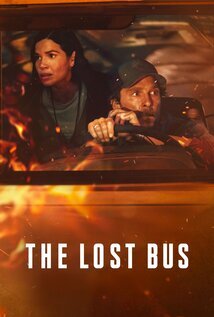

The Lost Bus



Produced by Gregory Goodman, Jamie Lee Curtis, Brad Ingelsby, and Jason Blum
Editing: William Goldenberg, Paul Rubell, and Peter Dudgeon
Music: James Newton Howard
Release Date: 19 September 2025
Aspect Ratio: 2.39 : 1
Color: Color
The most shocking thing in this "inspired by real events" disaster movie from Apple Studios, Blumhouse Productions, and producer Jamie Lee Curtis is the director's credit at the end. I didn't know this was a Paul Greengrass picture when I fired it up on my streamer, but when the credit popped up after the final fadeout, it was a big surprise that suddenly seemed not surprising at all. The Last Bus might be the most egregious example yet of a director making a film as bad, or worse, than one by his many imitators who quickly adopted his once-original style and made it the lazy, sloppy standard in a genre. Greengrass built his career making hyper-intense docudramas like Bloody Sunday, United 93, and Captain Phillips, in which recent events are dramatized, sometimes with major stars and sometimes with the actual participants, in an edge-of-your-seat manner that gets your heart racing. Greengrass pioneered an aggressive style: filming everything in anamorphic telephoto handheld shots and cutting them together in a rapid, frantic, seemingly random manner. The combination is meant to make the events depicted feel more "real," with a you-are-there immediacy that traditional cinematic coverage sometimes lacks. I am not a huge fan of this style, but I can not deny its effectiveness when properly utilized. Greengrass's "historical pictures" employed these techniques magnificently (they are far less effective in his completely fictional movies like the Bourne movies and the forgettable western News of the World).
The Lost Bus stars Matthew McConaughey as a down-on-his-luck bus driver named Kevin McKay. Kevin is dealing with divorce, a mom who's getting old, an estranged father who just passed away, and a son who doesn't like him any more than he liked his own pop. There's a ton of backstory to flesh out why Kevin is such a dick, but it just makes him seem like a dick with a bunch of problems that are probably his fault. (I wonder if this character is based ona real guy and what he thinks of this depiction.) When dry conditions and high winds keep firefighters from containing a mild blaze in Paradise, California, causing it to grow quickly into the disastrous "Camp Fire" of 2018, Kevin winds up trying to evacuate a class of elementary school kids.
Like the Starship Enterprise, Kevin's is the only bus in the quadrant. This is due to his constant personal needs, which render him chronically late and keep him high on the shit list of his supervisor (Ashlie Atkinson). On this day, he's tardy because he's had to drive way out of his way on a vital mission to buy some Avil or Dayquil for his sickly—a stakes-hieghtening narrative device that feels laughably anemic in relation to things like, ya know, the raging fire. So Kevin heroically drives the bus to pick up the kids, yelling at their teacher (America Ferrera) and doing his best to escalate everyone's anxiety. Of course, by the time they drive to the designated pick-up place, the fire has gotten worse, none of the parents are waiting for them, and the building looks like a bomb hit it. Our heroic, rebellious, and downright reckless bus driver must then take matters into his own hands for the good of everyone in his vehicle and his charge.
Unlike the sun-kissed high seas of Captain Phillips or even the narrow fuselage of United 93, the setting and circumstance of this movie hinder the action and intensity. You just can't really see much when you're in the middle of a fire. Even the silly fire-POV shots meant to show the speed of the spread aren't very exciting since fire is something the CGI masters still haven't perfected. The Oscar-nominated visual effects in this movie aren't terrible, but they're not especially convincing either. They certainly can't hold a candle (sorry) to the practical pyro effects in Ron Howard's Backdraft (1991) or Joseph Kosinski’s Only the Brave (2017). I'm surprised a director of Greengrass's stature and experience would sign on to a movie about a bus trapped in a fire, since there's no conceivable way to make memorable images from such a story. You can shake the camera all ya want, you can cut back and forth to the concerned authorities trying to give advice from a safe distance, you can shoot simple actions form multipul angles and slam cut all of them together till the cows come home (or burn in the field), but none of this changes the central conundrum that smoke inside a vehicle makes everything dark and hard to see.
A real-life disaster movie that lays everything on so thick that it strains all credibility features a surprisingly unpleasant turn from Matthew McConaughey and direction from Paul Greengrass that you'd swear was done by one of his imitators.